-
EnvironmentJan 22, 2026
Seawater Pollution and Governance Challenges in Lebanon
- Vatche Tchelderian
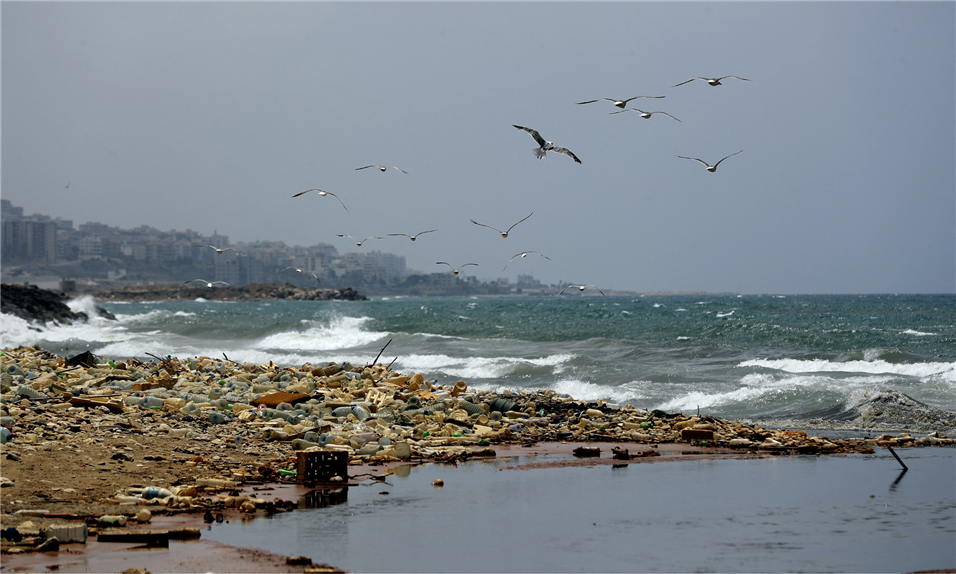 Photo by JOSEPH EID / AFP
This reform monitor is supported by the Royal Norwegian Embassy in Beirut. The opinions expressed here do not necessarily reflect those of the donor. LCPS would like to thank Dr. Milad Fakhri, Research Director at the National Center for Marine Sciences, for reviewing this monitor.
What is the Issue at Hand?
The 2025 annual report published by the National Center for Marine Sciences of the National Council for Scientific Research – Lebanon (NCSM/CNRS-L) provides an updated assessment of seawater and fish resource quality along the country’s coastline [1]. The yearly study examines samples taken from 38 sampling sites, mainly located on public beaches, and tests for the presence of bacteriological colonies, following the methodology recommended by the Program for the Assessment and Control of Marine Pollution in the Mediterranean (MEDPOL).
Overall, the report shows that out of the 38 monitoring stations, 24 (63%) sites are safe for swimming, 8 (21%) are marginal to unsafe, and 6 (16%) are heavily polluted. Specifically, the extremely polluted stations are in Tripoli (public beach), Jounieh (public beach), Dbayeh (North Dbayeh Marina), Antelias (Antelias River Mouth), and two sites in Beirut (Manara and Ramlet el Bayda Public Beach). The bacteriological status of all monitoring stations can be found on the interactive map created by NCSM/CNRS-L [2]. Compared to the results of 2024, nine stations recorded a deterioration in water quality and were downgraded in classification, with one station downgraded from safe to heavily polluted.
Although the 2025 report does not explicitly make this connection, the 2023 report linked the high levels of bacteriological contamination to wastewater and leachate (liquid that extracts components of the solids it passes through). The 2023 report also identified solid waste as a primary source of marine pollution in Lebanon, resulting in elevated levels of leachate.
Most Lebanese rivers carry sewage and organic waste directly into the sea, particularly near urban and industrial centers. The 2025 study shows that, over four seasons and covering four beaches (Ghlayghileh beach in Batroun, Kfar Abida beach, Ramlet al-Baida beach, and the Saida public beach), the number of solid waste items can exceed 20,000 pieces per 100 meters of coastline. Meanwhile, the threshold adopted by the Oslo and Paris (OSPAR) Commission recommends no more than 20 items per 100 meters. Most litter items on Lebanese beaches are plastic, followed by paper cardboard, glass, and metals [3].
Lebanese law prohibits the discharge of untreated waste into the sea. Environmental Protection Law 444/2002 establishes the right to a clean environment and requires pollution prevention measures [4]. Law 64/1988 (Preservation of the Environment against Pollution from Dangerous Waste and Hazardous Substances) regulates pollution from harmful substances to the marine environment [5].
Article 9 of this law criminalizes any person (natural or juridical) who “discharges into sea waters any chemicals, harmful wastes, or other materials that render the sea harmful for swimming or other uses, pose health risks, result in the death of fish or hinder their reproduction, compromise the suitability of fish as food for humans, or harm other marine animals and plants.” Lebanon’s Integrated Coastal Zone Management Strategy of 2025 (ICZM) complements the country’s marine protection framework [6].
Integrated Coastal Zone Management Strategy
The ICZM strategy, published in July 2025 under the Global Environment Facility (GEF) MedProgramme Child Project 2.1, is the first national comprehensive plan to preserve Lebanon’s coastal and marine resources. The strategy is based on a specific methodology called Drivers, Pressures, State, Impacts, Responses (DPSIR), with the objective of reducing coastal pollution, integrating spatial planning, protecting ecosystems, and improving the governance of the maritime public domain. It defines the coastal zone as the geomorphologic area where marine and terrestrial systems interact, encompassing inland rivers, wetlands, coastal waters, and offshore areas extending to 12 nautical miles, in accordance with Article 2 of the ICZM Protocol.
The ICZM strategy maintains that the key issue facing Lebanon’s coastal management is legislative inflation, i.e., multiple overlapping laws and regulations governing the marine environment. This has made implementation weak and ambiguous. Over 14 legal and regulatory instruments govern the coast—these include the Maritime Public Property Decision 144/S of 1925, Decrees 4809 and 4810 of 1966, Law 444/2002 on environmental protection, Law 163/2011 defining maritime zones, and sector-specific texts related to wastewater, fisheries, pollution control, and land use.
As a result, several violations occur with limited accountability, including illegal construction on the maritime public domain, unregulated discharge of wastewater, and industrial installations on the shoreline.
The ICZM strategy adopts Law 444/2002 as a general framework and reference for environmental protection. The draft ICZM law seeks to fill the institutional vacuum by establishing a single governance structure with clear mandates and by strengthening enforcement mechanisms against sources of pollution and illegal occupation. From an institutional perspective, it calls for inter-ministerial coordination among the Ministry of Environment, Ministry of Public Works and Transport, and Ministry of Energy and Water, as well as clearer roles for municipalities in coastal management.
Similar to the findings by NCSM/CNRS-L, the ICZM strategy identifies untreated wastewater discharge, industrial pollution, illegal coastal land use, sand extraction, and solid waste accumulation as the most urgent threats to the Lebanese coastline, noting that these pressures reinforce one another over time.
Fish Health and Environmental Implications
NCSM/CNRS-L also conducted an analysis of heavy metal concentrations in the tissue of 11 local fish species caught from Tyre, Beirut, and Tripoli. All species had levels of cadmium, lead, and mercury below the maximum thresholds set for contamination. The tentative conclusion is that fish can be safely caught and consumed when they are taken from areas far from sewage outfalls or industrial discharge points.
Fish health serves as an indirect indicator of marine ecosystem integrity. Despite the current stability, persistent pollution risks could threaten fish stocks and food safety if not managed. The International Union for Conservation of Nature (IUCN) 2022 Eastern Mediterranean Fish Field Guide stresses that Lebanon’s fish populations are sensitive to water temperature and nutrient changes, which makes them vulnerable when pollution alters their habitat [7].
The ecosystem approach to fisheries introduced in the 2022 FAO report recommends linking fishery management with water quality control. In Lebanon, this approach remains unimplemented due to limited coordination between agencies [8].
Why Is This Important?
Polluted seawater poses direct risks to public health and food safety. Marine pollution hinders economic recovery through its effects on tourism, fisheries, and the coastal economy. The findings by NCSM/CNRS-L provide clear scientific evidence that Lebanon’s coastal environment continues to deteriorate. Although environmental governance in Lebanon is rooted in existing laws, the capacity of responsible bodies to implement them is lacking due to the excessive volume and complexity of the legislative base.
Seawater cleanliness, therefore, offers a concrete entry point for advancing transparency and accountability. Reforms require operationalizing wastewater and solid waste laws and ensuring that seawater monitoring data (such as those made public by NCSM/CNRS-L) are linked to enforcement agencies. It is therefore important to align the production of data with enforcement mechanisms to reduce the gap between documented pollution and institutional response.
Ultimately, Lebanon’s geographical location and its climate are valuable “soft capital” that the country can leverage for economic activity and improvements in living conditions. Maintaining acceptable seawater quality is tantamount to preserving these assets.
From a policy perspective, protecting the coastal environment depends less on introducing new legislation and more on unifying and implementing existing legal and regulatory frameworks in a consistent manner. Macro reforms in the marine sector are needed not only to improve public health, but also to monetize the country’s unique endowments and achieve economic recovery.
References
[1] National Center for Marine Sciences. (2025). Status of the Marine Environment in Lebanon: Annual Monitoring Report 2025. National Council for Scientific Research – Lebanon (CNRS-L). https://cnrs.edu.lb/wp-content/uploads/2025/10/Marine-Report-CNRSL_NCMS_2025.pdf
[2] National Center for Marine Sciences (2024). Bacteriological Status of Monitoring Stations along the Lebanese Coast. National Council for Scientific Research – Lebanon (CNRS-L). https://sunar-cnrs.maps.arcgis.com/apps/instant/minimalist/index.html?appid=4c3d60b21bff459191abffdcf11df366
[3] OSPAR Beach litter expert group (BLEG), Lacroix, C., André, S., Meland Rød, A., van Loon, W.M.G.M., Blidberg, E., Moura, I., Price, L., Russell, J., Schulz, M., Sepúlveda, P., Strand, J., Zorzo, P., Bjarnadottir, K. (2025) CEMP Guidelines for marine monitoring and assessment of beach litter. OSPAR Agreement 2020-02, update 2025. https://www.ospar.org/documents?v=44122
[4] Republic of Lebanon. (2002). Law No. 444/2002 on environmental protection. Official Gazette. http://77.42.251.205/Law.aspx?lawId=244662
[5] Republic of Lebanon. (1988). Law No. 64/1988 on the preservation of the environment against pollution from dangerous waste and hazardous substances. Official Gazette. http://77.42.251.205/LawArticles.aspx?LawTreeSectionID=245620&LawID=244381&language=ar
[6] Priority Actions Programme Regional Activity Centre. (2025). Integrated Diagnostic Analysis Report. Lebanon’s National Integrated Coastal Zone Management (ICZM) Strategy, Legislation, and Plan Development. PAP/RAC, UNEP, Global Environment Facility. https://gefmed.paprac.org/wp-content/uploads/2025/09/Lebanon-ICZM-Strategy-Integrated-Diagnostic-Analysis-Report.pdf
[7] Samaha, Z., Husseini, M., & Bariche, M. (2022). Eastern Mediterranean fish field guide. IUCN. https://portals.iucn.org/library/sites/library/files/documents/2022-015-En.pdf
[8] Vasconcellos, M. & Ünal, V. (2022). Transition towards an ecosystem approach to fisheries in the Mediterranean Sea – Lessons learned through selected case studies. FAO Fisheries and Aquaculture Technical Paper No. 681. Rome, FAO. https://openknowledge.fao.org/items/a46ca831-a699-4120-81e9-609f66d4e5ba
Vatche Tchelderian is an economic researcher at the Lebanese Center for Policy Studies (LCPS) and a graduate of the Lebanese American University (LAU), where he earned a Master of Arts in Applied Economics. During his studies, he led the research team at LAU's Department of Economics and was awarded the Young Researcher Award in the field of Social Sciences and Humanities. He has multiple academic papers published in peer-reviewed journals in the fields of labor economics, international economics, and international banking and finance. He has also provided consulting support to international organizations, including the International Labour Organization (ILO), where he developed frameworks to integrate employment considerations into trade and investment policies in Lebanon.