-
EconomyApr 30, 2026
Foreign Labor Market Reform in Lebanon
- Lina S. Maddah
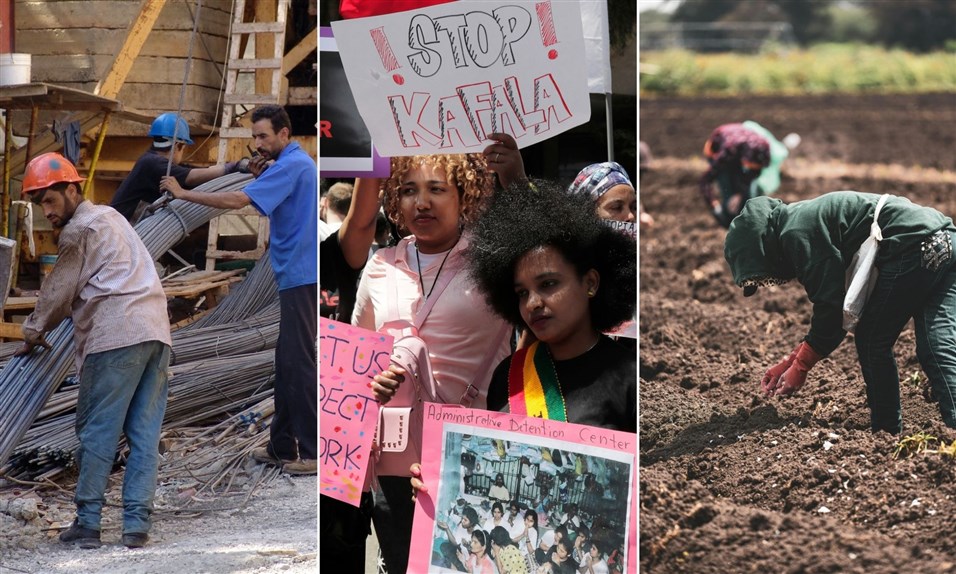 Image credits (left to right): Charles Fred / Flickr; Anwar Amro / AFP; Cristan Rojas / Pexels.
This reform monitor is supported by the Royal Norwegian Embassy in Beirut. The opinions expressed here do not necessarily reflect those of the donor.
What’s the Issue at Hand?
Migrant workers comprise nearly one in four workers in Lebanon, constituting a large share of the country’s domestic, agricultural, and construction sectors. Yet despite their economic importance, they continue to operate under fragile legal and social protections that leave them exposed to systemic exploitation.
Between 2018 and 2021, the Ministry of Labor recorded 745,025 work permits, including first-time entries and renewals. However, this figure captures only a portion of the reality, as tens of thousands of workers remain outside the formal system, largely due to informal recruitment channels and the Kafala (sponsorship) system that governs their legal status.
Under the Kafala system, a migrant’s residency is tied to a specific employer (the kafeel), who controls their work permit, renewal, and even right to leave the country. This framework has resulted in systemic exploitation—ranging from wage theft, passport confiscation, and excessive working hours to restrictions on movement. According to the International Labor Organization (ILO), migrant domestic workers in Lebanon, estimated at 250,000, are predominantly women from Ethiopia, the Philippines, and Sri Lanka, with 72% reporting abuse and 40% experiencing wage theft.
The economic collapse since 2019, compounded by the COVID-19 pandemic and the Beirut port explosion, has further exposed the fragility of this labor system. As the Lebanese pound lost over 98% of its value, many employers defaulted on salaries, while foreign workers—often paid in local currency—saw their purchasing power evaporate. The crisis also prompted large outflows of skilled and unskilled foreign labor, straining critical sectors and amplifying informality.
At the same time, the lack of a national system to anticipate labor market needs or regulate recruitment has thrown supply and demand out of balance. Employers continue to depend on low-cost, unprotected labor, while the state remains without the mechanisms to steer foreign labor inflows toward economic priorities or human rights commitments.
Out of Step with Modern Realities
Lebanon’s foreign labor framework is trapped in the past—disjointed, reactive, and ill-equipped to safeguard workers’ rights or to serve the changing demands of a struggling economy. The Kafala system, inherited from outdated sponsorship models used across the Arab region, continues to undermine fair labor practices and institutional accountability.
Comparative analysis from other contexts shows that more data-driven and rights-based systems can improve both economic efficiency and worker protection. For instance, Spain’s Catalogue of Difficult-to-Cover Occupations (CDCO) provides a dynamic, quarterly assessment of labor shortages across regions and sectors, ensuring that foreign workers are recruited only where domestic supply is insufficient. Italy’s Excelsior Survey, developed by the Ministry of Labor and UnionCamere, systematically forecasts skill shortages across 27 sectors and integrates demographic, occupational, and regional projections. Such approaches align foreign labor inflows with market realities and help governments anticipate structural changes.
In contrast, Lebanon’s labor governance lacks coordination between the Ministry of Labor, the Central Administration of Statistics (CAS), and employers’ associations. This leads to poor-quality data, unclear quotas, and reactive policymaking. Informal recruitment agencies often operate unchecked, while weak inspection mechanisms allow the proliferation of unregistered labor, particularly in domestic and agricultural work.
Moreover, Lebanon’s reliance on low-skilled, low-cost migrant labor discourages investments in skills development for its own citizens. With foreign workers concentrated in construction, services, and care work, employers have little incentive to train Lebanese workers or raise productivity. The outcome is a dual labor market—one formal but shrinking, the other informal, cheap, and largely invisible to policy.
Urgent Need for Reform
Reform of Lebanon’s foreign labor framework is imperative—driven equally by the demands of economic recovery and the principles of social justice. The collapse of the pre-crisis model—built on financial inflows, remittances, and cheap labor—has created an opportunity to rethink the role of foreign workers in a productive and inclusive recovery.
First, strengthening labor market assessment mechanisms is essential. A national system should regularly measure foreign labor demand, taking into account demographic trends, sectoral needs, and regional variations. The Lebanese government can adapt elements from Spain’s CDCO or Italy’s Excelsior system by developing a Labor Market Information System (LMIS) that integrates data from the Ministry of Labor, the National Social Security Fund, and private-sector employers.
Second, recruitment practices must be formalized and regulated. Currently, most foreign workers are hired through private agencies that charge exorbitant fees and operate with minimal oversight. Drawing on international best practices, Lebanon could implement ethical recruitment standards, ensure transparency in contracts, and cap recruitment fees paid by workers. These steps would align Lebanon with the ILO’s Fair Recruitment Initiative.
Third, bilateral labor agreements can play a central role in managing inflows and protecting worker rights. Spain’s bilateral recruitment agreements with Morocco and Colombia, and Bahrain’s Labour Market Regulatory Authority (LMRA) model—which introduced the Flexi Permit allowing certain categories of workers to work without direct sponsorship—offer valuable lessons. While Bahrain’s experience shows that reforms must be accessible and affordable, the principle of separating residency from employer control remains a cornerstone of rights-based migration management.
Finally, reforms should prioritize decent working conditions and wage protection. Qatar’s 2020 labor law reforms—introducing a non-discriminatory minimum wage and removing the “No Objection Certificate”—represent a turning point in the Arab region. Adapting similar mechanisms in Lebanon would ensure that all workers, foreign and national, benefit from basic labor protections and fair pay structures.
Towards a More Equitable System
Lebanon can take a series of concrete steps to align its foreign labor policies with both economic efficiency and international human rights norms:
- Transition from the Kafala to a Contract-Based System
Tie residency permits to the job rather than the employer, enabling workers to change jobs without losing legal status. This would reduce exploitation and foster a healthier employer-employee dynamic. - Establish a National Labor Market Observatory
Collect and analyze data on employment trends, wage levels, and foreign labor demand to inform policy design and annual quota setting. - Enhance Institutional Capacity and Enforcement
Empower labor inspectors, expand digital registration systems, and strengthen grievance mechanisms through a transparent complaints portal accessible to all workers. - Promote Skills Development and National Employment
Invest in robust vocational and technical training programs to equip Lebanese workers with skills currently dominated by foreign labor, reducing dependency while ensuring the economy retains access to specialized expertise. - Negotiate Bilateral and Regional Labor Agreements
Formalize labor migration channels with sending countries to ensure ethical recruitment, protection, and social security coordination. - Extend Legal Protections to Domestic and Informal Workers
Include domestic and agricultural workers under the labor law and social protection schemes to ensure fair treatment, social security coverage, and access to justice.
These measures are not only feasible but also essential for improving Lebanon’s competitiveness and compliance with international commitments, including ILO conventions on decent work and migration.
Why Is This Important?
Reforming the foreign labor market is central to Lebanon’s economic recovery, social cohesion, and international credibility. A fair and well-regulated system would help reduce informality, improve data accuracy, and attract responsible employers. It would also enhance the effectiveness of national employment policies, ensuring that Lebanese citizens are not displaced while foreign workers’ rights are safeguarded.
Formalizing and regulating foreign labor can contribute to GDP growth, productivity gains, and fiscal transparency. According to estimates by the Lebanese Center for Policy Studies, improving labor governance and worker protection could add up to 2% to annual GDP growth by boosting formal employment and innovation. Moreover, reducing informality will improve tax collection and social security contributions, creating fiscal space for social programs.
Beyond the economic argument, reforming the foreign labor system is a matter of human dignity and justice. Migrant workers have been integral to Lebanon’s households, hospitals, and construction sites for decades. Recognizing their contribution through fair treatment and transparent regulation is both a moral obligation and a strategic investment in the country’s future.
References
- International Labour Organization (ILO). Labour Migration in the Arab States, Beirut, 2019.
- International Organization for Migration (IOM). Needs and Vulnerability Assessment of Migrants in Lebanon, 2021.
- Lebanese Center for Policy Studies (LCPS). Foreign Labor Market in Lebanon amid Compounded Crises, 2022.
- World Bank. Lebanon Economic Monitor, 2019.
- OECD. International Migration Outlook, 2009.
- Migrant Rights Organization. A Closer Look at Bahrain’s Flexi-Permit Two Years On, 2020.
- ILO. COVID-19 Pandemic: Wage Protection of Migrant Workers in the Arab States, 2021.
- Government of Qatar, Labour Reform Updates, 2021.
- UnionCamere & Italian Ministry of Labor. Excelsior Survey Reports, 2020–2022.
- Public State Employment Service (Spain). Catalogue of Difficult-to-Cover Occupations, 2021.
Lina S. Maddah is a Senior Economic Researcher at the Lebanese Center for Policy Studies. Her areas of work include Urban and Regional Economics, Firm Dynamics, Spatial Economic Analysis, Cultural and Creative Industries, and Local Entrepreneurship Ecosystems. Lina holds a Ph.D. in Economics from Universitat Rovira i Virgili, Spain, and is an Adjunct Professor at the Department of Economics at the Lebanese American University.