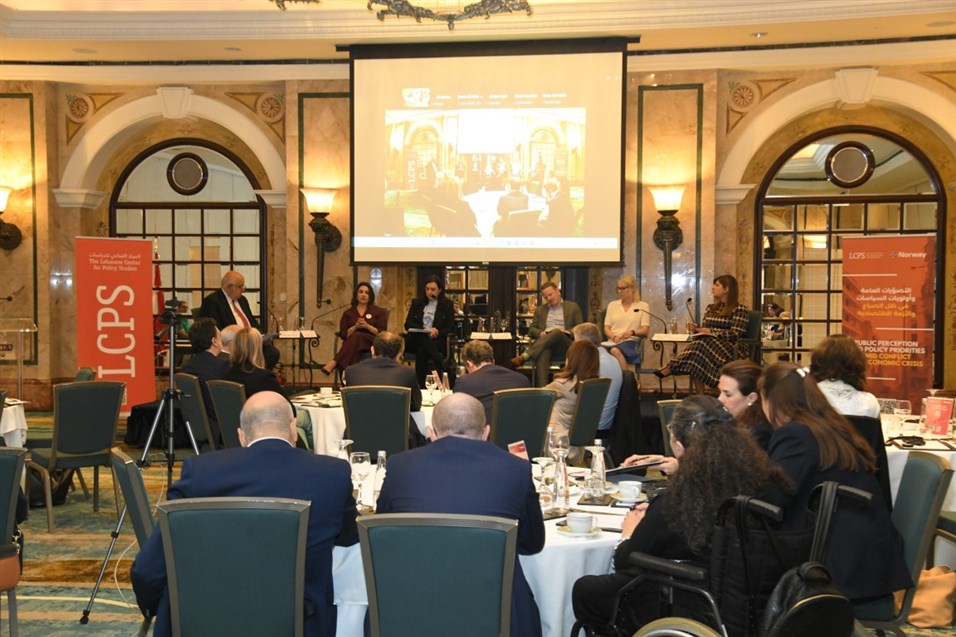
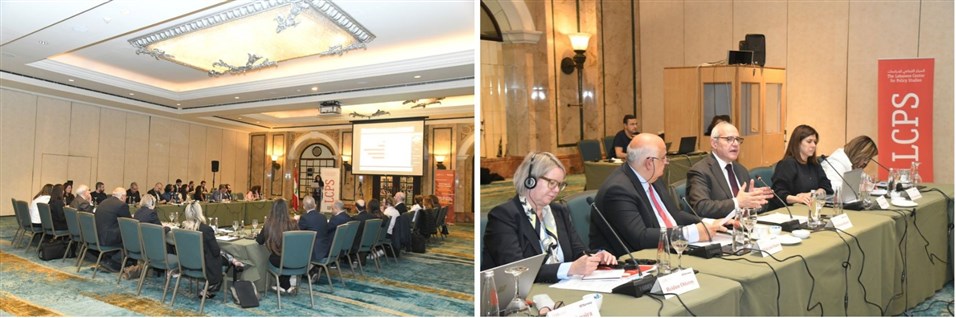
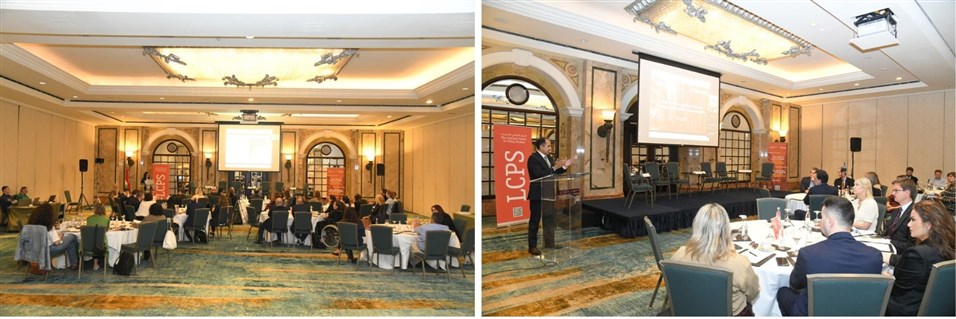
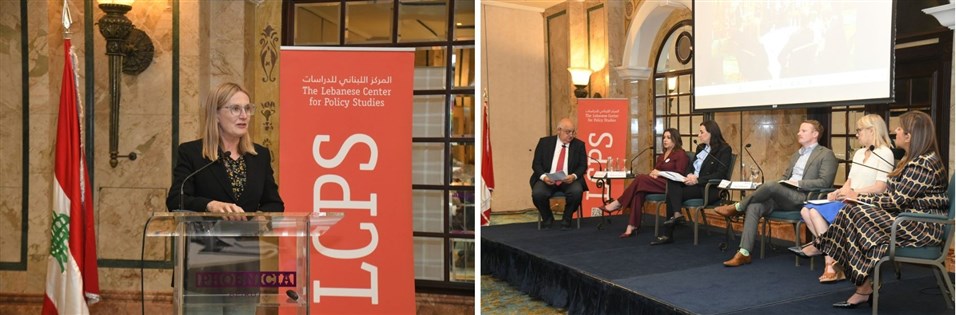
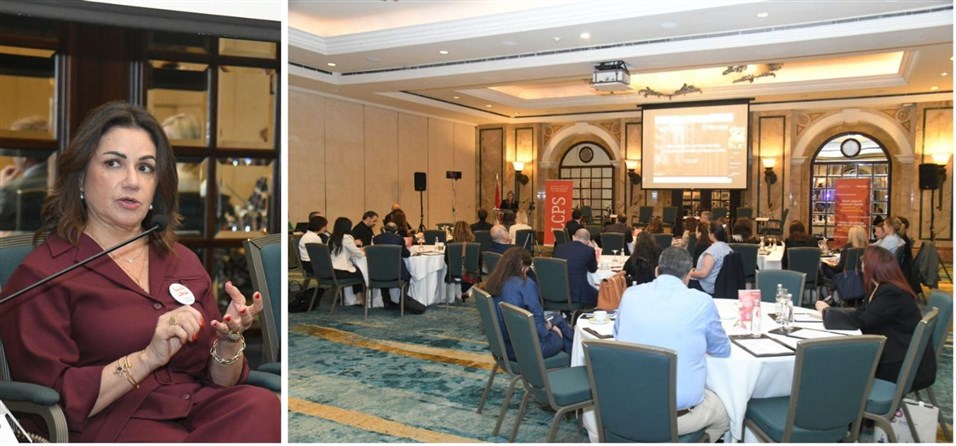
At a time of renewed military escalation, mass displacement, and severe economic strain, LCPS convened two roundtables on May 7 and 13, 2026, with support from the Royal Norwegian Embassy in Beirut, bringing together parliamentarians, government representatives, members of the diplomatic community, international and national organizations representatives, academics, and policy experts.
The roundtables, titled "Public Perceptions and Policy Priorities in Lebanon amid Conflict and Economic Crisis," centered on the findings of a nationwide survey of 2,400 respondents and 21 focus group discussions conducted across Lebanon in January and February of 2026.
The findings presented by LCPS Senior Researcher Dima Smaira explored socio-economic pressures, insecurity, trust in institutions, psychosocial well-being, displacement, gendered impacts, and future outlooks amid ongoing conflict and overlapping crises.
The first roundtable opening remarks were delivered by LCPS Executive Director Makram Ouaiss and Deputy Ambassador to the Royal Norwegian Embassy in Beirut Ms. Reidun Otterøy and featured interventions by Member of Parliament Melhem Khalaf, Arcenciel General Director Rana El Asmar, and Caritas Director of Programs Mary Anoushahodian.
The second roundtable opening remarks were delivered by LCPS President of the Executive Board of Directors Mohamed Alem and Ambassador of Norway to Lebanon and Syria, Her Excellency Hilde Haraldstad. The roundtable featured interventions by Lebanon Minister of Social Affairs, Her Excellency Haneen Sayed, Amel Board of Directors Member Zeina Mohanna, International Crisis Group (ICG) Senior Analyst David Wood, UNHCR’s Representative in Lebanon Karolina Lindholm Billing, and UN Women Program Management Specialist Jumanah Zabaneh.
Delivering his opening remarks, Mohamed Alem, President of LCPS’s Executive Board of Directors, emphasized that when there is a “separation between people’s expectation and public policies…we get closer to an abyss where no trust leads to violence,” adding that “the most important part is that we take these findings and put them in a proper format for actual execution, as part of the revival of Lebanon and the way forward.”
Her Excellency Hilde Haraldstad, Ambassador of Norway to Lebanon and Syria, highlighted the value of citizen-centred research for policy making: “The findings in this nationwide survey offer more than data. They provide information that contributes to understanding current dynamics, informing policy priorities, and bridging gaps between citizens’ needs and governmental decision-making.” She concludes that “humanitarian assistance is not a replacement for political and economic reforms," underscoring "the important role of the government and of strengthening of state institutions, which are crucial both for addressing the crises and for long-term political solutions for Lebanon.”
Lebanon’s Minister of Social Affairs, Her Excellency Haneen Sayed, reflected on the study and its significance stating: “This is the kind of research we need to do more and more of in Lebanon.” She added that after the “last war in 2024, Lebanon received $700 million of support…as of today, we are at $250 million." The minister concluded by thanking the international community and calling for further support at this critical time.
The discussant and participant interventions covered priorities for the coming phase, including relief, recovery, governance, and social cohesion, while exploring how citizen perspectives can better inform context-sensitive policy responses in Lebanon.
For more information, see this article summarizing the key findings.