-
GovernanceJul 15, 2026
Can Lebanon’s Social Protection System Withstand Wartime Shocks?
- Vatche Tchelderian
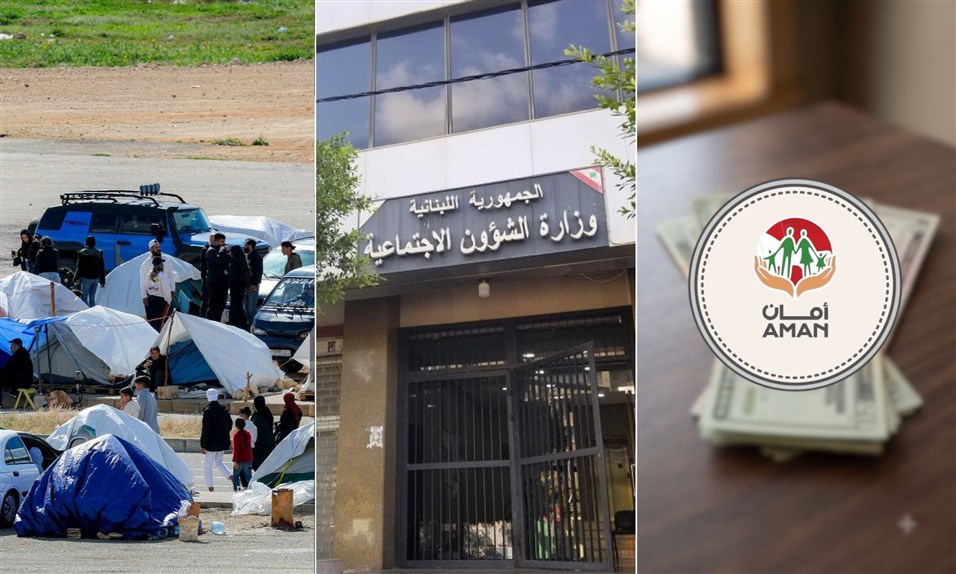 Photo by JOSEPH EID / AFP
This reform monitor is supported by the Royal Norwegian Embassy in Beirut. The opinions expressed here do not necessarily reflect those of the donor.
What is the issue at hand?
Since 2023, the war between Lebanon and Israel has severely impacted the socioeconomic status of households across the country. More than a million residents were forcibly displaced as many areas were threatened, houses and villages destroyed, and the overall disruption of economic activity increased financial pressure on families.
Economically, citizens have faced deteriorating incomes, higher prices, and new costs related to relocating and reconstruction, pushing them closer, or below, the poverty line. A survey conducted by LCPS with over 2,400 Lebanese nationals in January 2026, a few weeks ahead of the March military escalation, showed that a third of respondents experienced a reduction in income, and 30% reported a decline in business activity [1]. Government institutions were unable to respond quickly and effectively largely due to fiscal constraints.
Households have been forced to adopt coping strategies to manage mounting socioeconomic pressures. More than two-thirds of survey respondents reported a reduction in spending on food and clothing, utilities, and social activities. 32% of households have also reduced or delayed medical expenditures (such as health insurance, doctor's appointments, and medicine). Furthermore, 15% of respondents were forced to borrow to cover their needs. The evidence shows that households, especially in conflict-affected areas, are absorbing wartime socioeconomic shocks by consuming less food, postponing healthcare, drawing down assets, and taking on debt.
An equitable and inclusive social policy is central in such crises. Social protection programs and systems, including cash assistance, healthcare support, unemployment benefits, and pensions, can help offset these shocks and prevent households from falling into deeper vulnerability.
In the Lebanese context, the limited reach of formal social protection programs has constrained their capacity to absorb wartime shocks. Among respondents who received support to mitigate the effects of the war, 52% received assistance from political parties, while only 13.9% received it from state institutions.
This pattern also varies across regions. In governorates most affected by the war, such as in South Lebanon, Nabatieh, and Bekaa, support is reported to come more frequently from political parties and local networks than from state institutions. This highlights a gap in the reach of formal social protection programs in areas most impacted by the war.
Social protection in Lebanon tends to operate through a mix of national programs, fragmented institutional arrangements, and externally supported interventions. However, existing mechanisms have not yet developed into a unified framework capable of responding consistently to large-scale shocks.
Wartime social protection: Programs and numbers
The primary vehicle for cash assistance during the ongoing conflict has been the AMAN program, a unified social safety mechanism consolidating the former National Poverty Targeting Program (NPTP) and the Emergency Social Safety Net (ESSN) led by the Ministry of Social Affairs (MoSA).
The program represents a major shift toward a more institutionalized social safety net. Unlike ad hoc aid programs, it relies on a national social registry (DAEM) and certain eligibility criteria. AMAN provides cash rather than in-kind assistance, giving households flexibility in meeting their needs.
Funded by the World Bank and launched in 2022, AMAN provides monthly transfers of $25 per household plus $20 per family member (up to six members). Although estimates vary, according to the MoSA 2026-2030 Strategy, AMAN is financially assisting 166,000 families – approximately 800,000 individuals – with monthly transfers of $22 million [2], making it the largest social assistance program in Lebanon.
Another direct cash-transfer program is the National Disability Allowance (NDA) – Lebanon’s first program that provides direct income support to individuals with disabilities. Currently, the NDA covers children and youth from the ages of 0-31 and elderly people aged 65 and above. Each of its 33,500 recipients gets a monthly cash transfer of $40 [3]. Importantly, the NDA has shifted from full donor dependence to partial national financing. The Lebanese government made its first direct budget allocation to the program of $5 million in 2024 and increased it to $10 million in 2025 [4].
Beyond social assistance programs, recent reforms have also sought to strengthen longer-term social insurance mechanisms. Lebanon passed Law 319/2023 to overhaul the pension system in December 2023, introducing a comprehensive pension scheme for private-sector workers through the National Social Security Fund (NSSF) and replacing the end-of-service indemnity system, whose value had been severely eroded by the currency collapse.
The new scheme provides lifetime pensions indexed to inflation and covers old age, disability, and survivor benefits [5]. The reform remains in the implementation phase, as approximately 850,000 records are still being digitized as of late 2025 [6].
In practice, private-sector workers displaced or affected by the war had no access to pension-based income during the war. Broader questions regarding the long-term sustainability and coverage of pension arrangements across both the public and private sectors also remain unresolved.
In addition, Lebanon has no formal unemployment insurance system, and around 65% of workers remain outside any form of social protection. The war exposed these gaps further, contributing to an estimated 166,000 job losses and $168 million in lost earnings, while informal workers, women, youth, and migrants remained largely excluded from formal support mechanisms [7].
Are current social protection efforts enough?
Although the government has made incremental progress in responding to the crisis, the scale of these efforts falls far short due to severe structural constraints. MoSA, like other ministries, has not recovered from the financial collapse in 2019. MoSA’s 2026 budget amounts to $181 million (around 3% of the budget) [8]. Of MoSA’s total budget, $53 million is allocated to the AMAN program, marking the first time the government has financed the program through the national budget. That being said, AMAN alone disburses $22 million per month, a sum that exceeds what the Lebanese state could plausibly finance domestically with the current budget, making the program almost entirely dependent on World Bank financing. This raises important questions on the sustainability of the program as a whole.
The adequacy of the monthly cash transfers—for both AMAN and NDA—is also a concern. In AMAN, a family of five would receive $25 upfront and $20 per family member, totalling $125. This represents less than a quarter of the monthly minimum expenditure basket estimated at $509 for a family of five [9]. Although these programs provide important income support, they do not come close to replacing lost earnings or covering the full cost of displacement.
Taken together, the evidence suggests that Lebanon’s social protection system remains ill-equipped to absorb large-scale wartime shocks due to limited coverage, donor dependence, and the absence of key protection mechanisms such as unemployment insurance.
Why is this important?
At the most basic level, the evidence shows that Lebanese citizens are self-insuring against crises through informal coping strategies. When over half of those who received support during the war did so through political parties rather than state institutions, this reflects a social contract that still runs through political patronage rather than public institutions.
The war in Lebanon also highlighted the immense social cost of delayed reform. A social protection system that waits for the emergency to materialize before building its mechanisms will always be too slow, too narrow, and too dependent on outside financing.
MoSA’s various social protection programs, the pension law, and other reforms have shown that investment in such programs does produce results. However, these building blocks can only translate into a functioning and responsive system when they rest on firm foundations, including: 1) a unified social registry that can identify the vulnerable before the shock, 2) a domestic financing mechanism that does not require a donor pledge to activate, and 3) standing emergency spending protocols capable of rapidly expanding support during periods of crisis without depending on ad-hoc financing or delayed budgetary approvals.
References
1. Lebanese Center for Policy Studies. (forthcoming). Public Perceptions and Lived Experiences in Lebanon Prior to the 2026 Escalation.
2. Ministry of Social Affairs. (2025). Lebanon Social Protection Strategy 2026-2030. Government of Lebanon. https://www.socialaffairs.gov.lb/media/140nkrho/mosa_strategy_eng.pdf
3. International Labour Organization. (2024, October). ILO and partners take shock-response measures to support persons with disabilities in Lebanon. https://www.ilo.org/resource/news/ilo-and-partners-take-shock-response-measures-support-persons-disabilities
4. International Labour Organization. (2025, October). Lebanon scales up domestic financing for the National Disability Allowance. https://www.ilo.org/resource/article/lebanon-scales-domestic-financing-national-disability-allowance
5. International Labour Organization. (2024, February). Lebanon adopts landmark social security reforms and a new pension system for private sector workers. https://www.ilo.org/resource/news/lebanon-adopts-landmark-social-security-reforms-and-new-pension-system
6. International Labour Organization. (2025, October). Digitization of Lebanon's social security records marks major step toward implementing new pension scheme. https://www.ilo.org/resource/news/digitization-lebanon%E2%80%99s-social-security-records-marks-major-step-toward
7. Institut des Finances Basil Fuleihan. (2025, November). Review of Government Spending on Social Protection in Lebanon 2017–2024. https://institutdesfinances.gov.lb/sites/default/files/2025-12/Report-Review%20of%20Government%20Spending%20on%20Social%20Protection-Nov25-EN.pdf
8. Institut des Finances Basil Fuleihan. (2026, April). Citizen Budget 2026. https://www.institutdesfinances.gov.lb/sites/default/files/2026-04/Citizen%20Budget%202026-Apr26-En-final_0.pdf
9. Lebanon Response Plan 2026. (2026, February). Multipurpose Cash and Cash & Voucher Assistance Chapter. https://reliefweb.int/report/lebanon/lebanon-response-plan-2026-multipurpose-cash-and-cash-voucher-assistance
Vatche Tchelderian is an economic researcher at the Lebanese Center for Policy Studies (LCPS) and a graduate of the Lebanese American University (LAU), where he earned a Master of Arts in Applied Economics. During his studies, he led the research team at LAU's Department of Economics and was awarded the Young Researcher Award in the field of Social Sciences and Humanities. He has multiple academic papers published in peer-reviewed journals in the fields of labor economics, international economics, and international banking and finance. He has also provided consulting support to international organizations, including the International Labour Organization (ILO), where he developed frameworks to integrate employment considerations into trade and investment policies in Lebanon.