-
EconomyOct 08, 2026
Lebanon Under Wartime Pressures: Gaps in Employment Policy
- Vatche Tchelderian
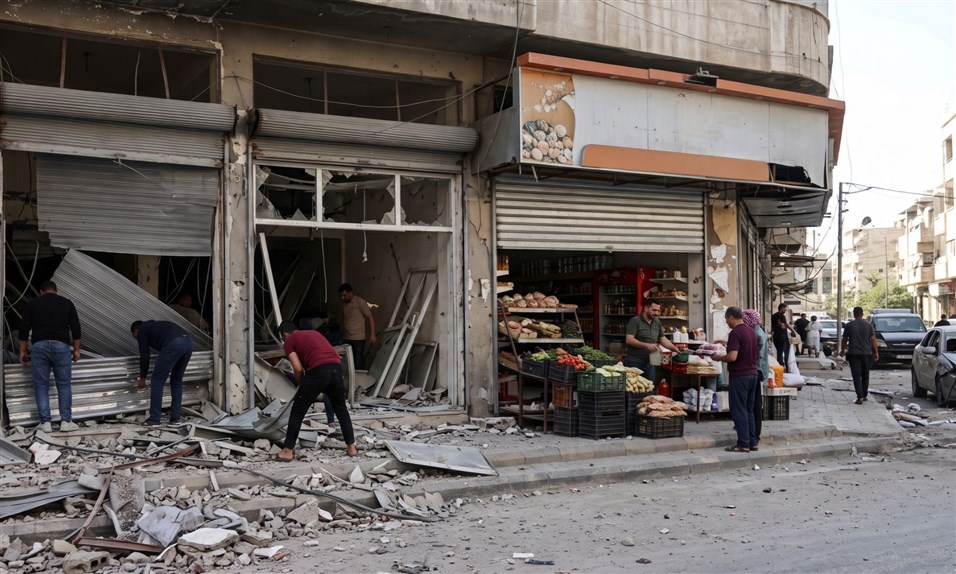 Image credits: AI created image
This reform monitor is supported by the Royal Norwegian Embassy in Beirut. The opinions expressed here do not necessarily reflect those of the donor.
What is the issue at hand?
Lebanon entered the 2023-2024 war with Israel with an employment crisis already in place. According to the 2022 Follow-up Lebanese Labor Force Survey, unemployment had risen to 29.6%, compared with 11.4% in 2018-2019 [1]. Youth unemployment had reached 47.8%. Informal employment accounted for 62.4% of all employment. The war therefore hit a labor market that was already weakened by the 2019 economic collapse, the Covid-19 pandemic, and the Beirut port explosion, after which stable jobs and formal protection became scarcer.
The 2024 war aggravated these pressures, as the World Bank estimated that, by November 2024, 166,000 jobs were lost, which translated into USD 168 million in lost earnings [2]. A later UNDP-ESCWA assessment found private-sector employment fell by 25% during the war. In areas most heavily affected by bombardment, 36% of workers lost their jobs, compared with 17% in less-affected areas. Among workers who remained employed, 35% saw earnings fall, while average earnings declined by 15% nationwide [3].
The Lebanese Center for Policy Studies (LCPS) conducted a nationwide survey of 2,400 respondents in January 2026 to assess living conditions of Lebanese residents during the war, as well as to gauge citizens’ needs [4]. Around 34% of respondents reported a reduction in household income, 30% reported declining business activity, and 9% reported employment loss since the conflict began.
Employment emerged as the leading near-term socioeconomic concern, as 50.6% identified “job opportunities and a more productive economy” as a pressing need, rising to 58.4% among those aged 18-24 and 60.8% among those aged 25-34. Focus-group participants also described periods without salaries, sudden pay cuts, and unfair labor practices.
Any recovery underway in early 2026 was interrupted by renewed escalation with Israel starting from March. An International Labor Organization (ILO) survey of 2,485 private-sector workers, conducted in May 2026, found one-third of sampled workers had lost their jobs. Combining job losses with lower earnings among those still employed, the ILO estimated that average labor income across the surveyed population had fallen by 40.4% [5].
In June 2026, Lebanon’s Ministry of Labor reported Israeli attacks had partially damaged more than 1,700 economic establishments and completely destroyed more than 500 [6]. The LCPS, ILO, and other estimates cover different samples and periods, so direct comparison would be misleading. Taking together, these statistics point to repeated employment shocks, starting from the economic crisis of 2019, and compounded by the outbreak of the 2024 war and the renewed March 2026 escalation. Taken together, these statistics show that Lebanon’s labor market has faced repeated shocks since the 2019 economic crisis, with conditions worsening further during the 2024 war and the renewed escalation in March 2026.
Program and Policy Responses to Employment Crises
Lebanon’s response has relied on a mix of government coordination and donor-funded programs. After the 2024 war, UNDP launched grants of $10,000 to $12,000 for eligible micro and small businesses affected by the conflict. Eligible spending included workers’ wages, materials, logistics, machinery, and operating needs, with job retention listed as a core objective [7]. The goal was to retain jobs rather than create new opportunities after firms shut down.
In May 2026 (following the second escalation), the Ministry of Economy and Trade convened donors and financial institutions around support for micro, small, and medium enterprises. The ministry reported around $130 million in available support through grants and subsidized lending from the World Bank and donors. It had completed an initial assessment of 200 firms to identify war-related damage and financing needs, while a broader survey is being prepared with UN partners [8]. The ministry also raised the possibility of using the AMAN social assistance program to target cash-for-work interventions.
One newly launched package is a €32 million, four-year recovery program supported by the EU, Denmark, and France for conflict-affected areas in South Lebanon and the Bekaa, including employment opportunities, agriculture, and local institutional support [9]. UNDP also launched stabilization grants of up to $6,000 for eligible Lebanese-owned MSMEs and cooperatives affected by the 2026 conflict, including wages during reopening, working capital, equipment, and minor rehabilitation [10].
In terms of policy coordination, the ILO brought together the Ministry of Labor, employers, and workers for the first time on 30 June 2026. The meeting focused on employment protection, enterprise recovery, and economic resilience [11]. Participants identified priorities around social protection, reducing informality, and supporting affected firms and workers, in addition to measures including wage support for SMEs, affordable finance, tax relief, and simplified business registration.
Are current employment efforts enough?
Although Lebanon’s response to the employment crisis during the war has expanded beyond emergency relief, the coverage and institutional capacity remain limited relative to the scale of wartime labor-market disruption. The main overarching issue is fragmentation. Lebanon still has no adopted national employment policy.
According to ILO’s Employment Policy Gateway, a national employment policy in Lebanon is “under development” in 2026 [12]. An independent evaluation of ILO’s ENABLE program, an EU-funded ILO program linking vulnerable groups to training, employment, and livelihood support, found the Ministry of Labor lacked the technical and financial capacity to implement active labor-market policies at scale. The Ministry’s National Employment Office of Lebanon also remains largely inactive because of weak digital infrastructure, staffing, and outreach [13].
The second problem is the balance between helping workers find jobs and assisting firms preserve or create them. Training, job matching, and public works matter, especially during displacement. Yet workers cannot be trained for jobs which are not in demand in the local market. The ENABLE evaluation found supply-side measures such as vocational training or cash-for-work had limited long-term impact without stronger labor demand [13].
Hence, wartime employment policy should focus more on helping affected businesses stay open and keep their workers, through temporary wage support, working-capital grants linked to job retention, and reconstruction contracts that prioritize local firms and workers. These short-term measures should be accompanied by broader economic and political reforms that improve the conditions for private-sector investment, business growth, and sustainable job creation.
Informality creates a third constraint. With 62.4% of workers already informally employed in 2022 [1], programs restricted to formally registered firms risk missing many marginalized people whose income was reduced during conflict. For instance, the 2024 and 2026 UNDP business grants both required formal registration. Parallel channels are therefore needed for informal and own-account workers, including employment-intensive public works, simplified temporary registration, and individual livelihood grants, alongside a gradual route into formal systems.
Financing and implementation speed also matter. Reconstruction and recovery needs from the 2023-2024 conflict alone were estimated at $11 billion [14]. The Lebanon Emergency Assistance Project (LEAP) is structured as a $1 billion reconstruction framework, but only $250 million is currently financed, leaving a $750 million financing gap. The project only went into effect in February 2026, with security and access restrictions causing further delays [15].
It is worth noting that the latest results framework tracks infrastructure and service restoration without a jobs or employment indicator. Adding targets for jobs retained, worker-days generated, local firms contracted, and female and youth employment would turn reconstruction spending into a tool for employment policies.
Why is this important?
Employment policy should become a key component of crisis response and recovery. In its 2026 survey, LCPS found 41.8% of respondents were considering emigration for economic reasons, while younger respondents placed job opportunities among their highest priorities [1]. Repeated cycles of job loss, lower earnings, displacement, and business closure deepen financial strains and make each subsequent recovery more difficult.
Lebanon already has useful local precedents. After the Beirut port explosion, the Building Beirut Businesses Back & Better Fund, a World Bank-managed, multi-donor fund implemented by Kafalat, supported 3,616 micro and small enterprises and preserved 10,375 jobs, with 93.8% of supported firms still operating six months after receiving support [16]. The UNDP’s Lebanon Host Communities Support Project has maintained 3,993 jobs and created 4,150 short-term employment opportunities, generating almost 160,000 worker-days [17].
Neither program replaces a national employment policy, but they show that there are tools successfully tested in Lebanon: rapid grants to viable firms, employment-intensive local projects, and measurable job-retention targets.
The next step is to bring these tools under one government-led employment recovery framework. Such a framework should identify affected workers and firms quickly, preserve viable jobs before businesses close, link reconstruction spending to local employment, cover informal and self-employed workers, and regularly track and publish results on jobs and earnings.
More broadly, Lebanon’s employment policy should build mechanisms to protect jobs and incomes before crises occur and allow support to be rapidly activated when shocks hit, rather than responding only after households lose their income and firms shut their doors.
References
- Central Administration of Statistics and International Labour Organization. (2022). Lebanon Follow-up Labour Force Survey, January 2022. https://www.ilo.org/sites/default/files/wcmsp5/groups/public/%40arabstates/%40ro-beirut/documents/publication/wcms_848353.pdf
- World Bank. (2024). New World Bank Report Assesses Impact of Conflict on Lebanon’s Economy and Key Sectors. https://www.worldbank.org/en/news/press-release/2024/11/14/new-world-bank-report-assesses-impact-of-conflict-on-lebanon-s-economy-and-key-sectors
- United Nations Development Programme and United Nations Economic and Social Commission for Western Asia. (2025). The Socioeconomic Impacts of the 2024 War on Lebanon. https://www.undp.org/sites/g/files/zskgke326/files/2025-08/2500251e-socioeconomic-impacts-lebanon-2024-war-web-report-jul30.pdf
- Lebanese Center for Policy Studies. (2026). Public Perceptions and Lived Experiences in Lebanon Prior to the 2026 Escalation. https://api.lcps-lebanon.org/content/uploads/files//489~Norway-project-report-EN.pdf
- International Labour Organization. (2026). Lebanon’s Labour Market in Crisis: Assessing the Impacts of Renewed Conflict and Regional Instability. https://www.ilo.org/sites/default/files/2026-07/ILO-Private%20sector%20workers%20report-%20Lebanon%20June%202026.pdf
- وزارة العمل اللبنانية. (2026). من جنيف... حيدر يضع المجتمع الدولي أمام مسؤولياته. https://alahednews.news/post/99438/حيدر-من-جنيف-لتعزيز-الدعم-الدولي-للبنان-ومساندته-في-مواجهة-التحديات-الراهنة
- United Nations Development Programme. (2024). Call for Proposal for Micro & Small Businesses to Benefit from UNDP Grants. https://www.undp.org/lebanon/call-proposal-micro-small-businesses-benefit-undp-grants
- وزارة الاقتصاد والتجارة اللبنانية. (2026). وزارة الاقتصاد تنظم اجتماعاً تنسيقياً رفيع المستوى لتسريع دعم المؤسسات الصغيرة والمتوسطة في لبنان. economy.gov.lb/ar/news/وزارة-الاقتصاد-تنظم-اجتماعاً-تنسيقياً-رفيع-المستوى-لتسريع-دعم-المؤسسات-الصغيرة-والمتوسطة-في-لبنان
- Delegation of the European Union to Lebanon. (2026). Lebanon Launches EUR 32 Million Programme for Conflict-Affected Areas with Support from the European Union, Denmark and France. https://www.eeas.europa.eu/delegations/lebanon/lebanon-launches-eur-32-million-programme-conflict-affected-areas-support-european-union-denmark-and_en
- United Nations Development Programme. (2026). Stabilization Micro-Grants for MSMEs and Cooperatives Affected by the 2026 War. https://www.undp.org/lebanon/stabilization-micro-grants-msmes-and-cooperatives-affected-2026-war
- International Labour Organization. (2026). Lebanon’s National Tripartite Dialogue Sets Shared Priorities for an Economic Recovery Grounded in Decent Work. https://www.ilo.org/resource/news/lebanon%E2%80%99s-national-tripartite-dialogue-sets-shared-priorities-economic
- International Labour Organization. (2026). Employment Policy Gateway: Lebanon. https://webapps.ilo.org/empolgateway/employment-policies/1/Lebanon
- International Labour Organization. (2025). Improving Living Conditions and Resilience of Refugees and Vulnerable Host Communities in Lebanon, ENABLE Mid-term Evaluation. https://webapps.ilo.org/ievaldiscovery/files/file/2357497
- World Bank. (2025). Lebanon’s Recovery and Reconstruction Needs Estimated at US$11 Billion. https://www.worldbank.org/en/news/press-release/2025/03/07/lebanon-s-recovery-and-reconstruction-needs-estimated-at-us-11-billion
- World Bank. (2026). Lebanon Emergency Assistance Project: Implementation Status & Results Report. https://documents1.worldbank.org/curated/en/099062926134535703/pdf/P509428-c4fc70f6-1b1a-434a-be1c-16cfa8a34a3c.pdf
- World Bank. (2026). Building Beirut Businesses Back & Better Fund: Implementation Completion and Results Report. https://documents1.worldbank.org/curated/en/099052226090016014/pdf/BOSIB-adbfe453-0287-443c-a39f-29b2d24a43bd.pdf
- United Nations Development Programme. (2024). Lebanon Host Communities Support Project, Phase 2. https://www.undp.org/lebanon/projects/lebanon-host-communities-support-project-phase-2-lhsp-20
Vatche Tchelderian is an economic researcher at the Lebanese Center for Policy Studies (LCPS) and a graduate of the Lebanese American University (LAU), where he earned a Master of Arts in Applied Economics. During his studies, he led the research team at LAU's Department of Economics and was awarded the Young Researcher Award in the field of Social Sciences and Humanities. He has multiple academic papers published in peer-reviewed journals in the fields of labor economics, international economics, and international banking and finance. He has also provided consulting support to international organizations, including the International Labour Organization (ILO), where he developed frameworks to integrate employment considerations into trade and investment policies in Lebanon.