-
GovernanceOct 29, 2026
Rethinking Security in Lebanon: From Citizen Priorities to National Strategy
- Dima Smaira
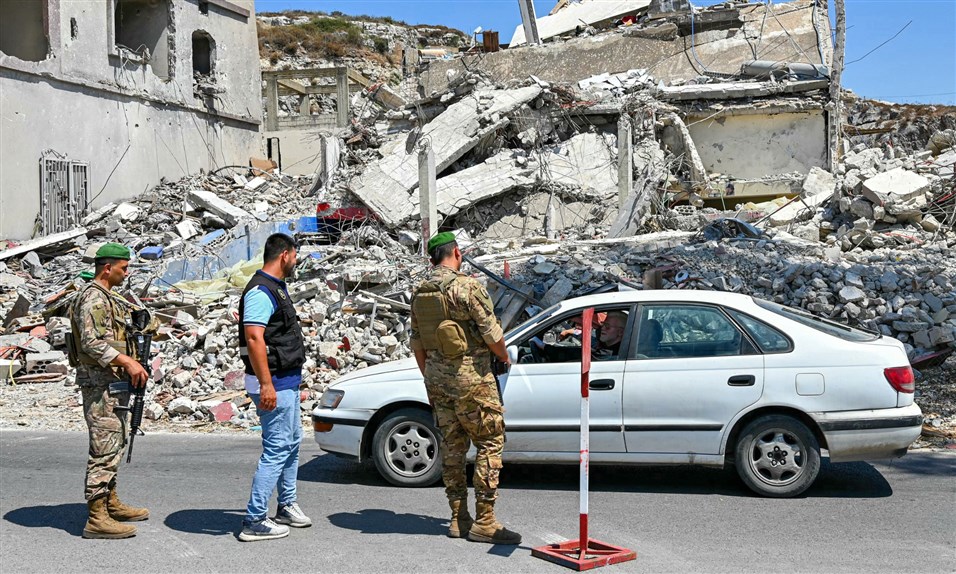 Photo by FADEL ITANI / AFP
This article is supported by the Royal Norwegian Embassy in Beirut. The opinions expressed here do not necessarily reflect those of the donor.
Why Lebanon needs a broader security strategy
Lebanon's overlapping crises and renewed conflict have underscored the need for a national security strategy that addresses the multiple dimensions of insecurity facing the country and its population. Yet the security debate has largely centered on weapons and the extension of state authority.
While fundamental, these issues need to be situated within a strategy that assesses how different sources of insecurity interact, establi
shes priorities, clarifies institutional responsibilities, and identifies the military, diplomatic, political, economic, and social measures needed to provide meaningful protection.
The March 2026 escalation has made this task more urgent. Renewed conflict between Israel and Hezbollah has caused widespread destruction, including of entire villages, and mass displacement, while continued occupation and attacks have left many communities facing profound insecurity and uncertain prospects for return and recovery.
The conflict has also underscored the consequences of military decisions taken outside state institutions. Addressing Hezbollah's autonomous military role is therefore essential, but how this is achieved must form part of a broader strategy for national defense and civilian protection.
The Lebanese government has taken steps to extend state authority over weapons and strengthen the role of the Lebanese Armed Forces (LAF). In his January 2025 inaugural address, President Joseph Aoun linked these objectives to an integrated defense policy within a wider national security strategy, which he has subsequently described as encompassing diplomatic, economic, institutional, and societal dimensions.
Yet these broader ambitions have received less attention than the immediate weapons question. International efforts to mobilize support for the LAF, including the September meeting in France and plans for an EU training and support mission, raise a critical question: Assistance for which security strategy? Without clearly defined national priorities, institutional responsibilities, and corresponding resources, changes in security arrangements may not translate into greater protection or public confidence.
Drawing on Lebanese Center for Policy Studies (LCPS) research conducted immediately before the March 2026 escalation, this article argues that citizens' experiences of insecurity and their security priorities should inform a broader, nationally owned and inclusive process for developing Lebanon's security strategy.
What Lebanese were telling us before the latest escalation?
Research conducted by LCPS in January and February 2026, immediately before the March escalation, combined a nationally representative survey of 2,400 Lebanese with 21 focus-group discussions across the country. The findings reveal how insecurity was experienced as multidimensional, cumulative, and prolonged.
When asked which threats most concerned their households, 57.3% selected economic insecurity, 41.7% internal political and sectarian conflict, 35.9% external attacks, and 30.3% theft or other criminal activity. Focus-group participants similarly described external violence, economic collapse, weak law enforcement, unregulated weapons and social fragmentation as layered and mutually reinforcing. After years of overlapping crises, the cumulative strain was itself a defining feature of insecurity.
These experiences also varied across regions. External attacks were especially prominent in governorates directly exposed to hostilities, while concerns about internal conflict and criminality were more pronounced elsewhere. A national security strategy cannot absorb every economic or governance problem. It should, however, assess how military, economic, political and everyday threats interact; establish priorities; clarify responsibilities among state institutions and their domestic and international partners; and identify the combination of military, diplomatic, economic, governance and social-policy tools required.
The findings reveal important differences beneath the LAF’s strong national standing. Nationally, 76.7% identified the LAF as the actor they trusted most to keep their community safe. But in areas directly affected by hostilities, focus-group participants often questioned whether the army had sufficient resources, capabilities or autonomy to provide protection.
The survey also showed a related sectarian variation: among Shia respondents, 56.5% selected the LAF and 30.3% selected political parties or armed groups. Among Christian, Sunni, and Druze respondents, more than 82% selected the LAF and fewer than 4% selected political parties or armed groups.
These findings reveal broad but uneven confidence in the LAF: it commanded majority trust across all groups, providing an important foundation for any security transition, while non-state actors retained meaningful support among Shia respondents.
Read alongside the regional findings and focus-group discussions, these differences should not be understood simply as competing allegiances between the state and Hezbollah. They may partly reflect unequal exposure to conflict and different assessments of whether state institutions can currently provide protection. Some participants associated non-state actors with rapid local support and defense; others viewed them as divisive or as contributing to insecurity and political fragmentation.
The same complexity appeared in respondents’ priorities for dealing with Israel. Ending attacks, securing Israeli withdrawal, and ensuring the return of detainees ranked first, at 47.4%, followed closely by strengthening the LAF at 45.5%. Reconstruction and the return of displaced people were selected by 35.5%, extending state authority nationwide by 34%, and disarming non-state armed groups by 31.2%.
These objectives are sometimes treated in political debate as competing positions. The findings suggest otherwise. Many Lebanese appear to expect an end to attacks, Israeli withdrawal, reconstruction and safe return, while also supporting stronger state institutions and greater public authority over security decisions. The challenge is therefore not to choose among these objectives, but to develop a strategy capable of pursuing them together.
There was less agreement over how to do so. Strengthening the 2024 ceasefire monitoring mechanism, pursuing direct negotiations, and rejecting negotiations altogether received broadly comparable levels of support nationally, with pronounced regional differences.
Debate over whether and how to negotiate is therefore not confined to foreign policy; in a polarized domestic context, disagreement over the legitimacy and form of negotiations can sharpen mistrust. A viable security transition must address both how Lebanon’s objectives will be pursued and how disagreement over the roadmap can be managed without deepening communal tensions.
The stakes are already high. By January 2026, 61% of respondents believed that social cohesion had weakened or somewhat weakened since the November 2024 ceasefire. Focus-group participants linked this deterioration to displacement, political polarization, and rhetoric that revived sectarian mistrust. Since then, the burdens of war and occupation have intensified and remained highly uneven.
In a deeply divided society, such disparities acquire wider political and communal significance, particularly where entire villages—and the livelihoods, services, institutions, and heritage sustaining life within them—have been destroyed, displacement prolonged, and return obstructed. Against this background, a security transition perceived as externally imposed—or as altering the balance of power against one section of the population without improving its security—could deepen existing divisions.
From a weapons policy to a security strategy
A national security strategy should not become simply another name for negotiations over Hezbollah’s weapons. Its purpose should be to connect any weapons transition to a credible plan for national defense and protection.
Sovereignty and statehood are central to Lebanon’s public debate, but both are often reduced to territorial authority and control over armed force. These are essential dimensions, not complete definitions. Sovereignty does not mean that states act alone: states exercise public authority through law and institutions while often fulfilling their responsibilities in partnership with domestic non-state actors and through international arrangements.
Effective statehood also depends on the capacity to protect people, provide services, and uphold rights, and on citizens’ recognition of public institutions as legitimate, representative, and worthy of trust. This does not mean that every failure of governance must be resolved before the weapons question can be addressed. It means that bringing coercive authority under state institutions will not, by itself, produce an effective or legitimate security order.
A national strategy must therefore address three linked questions. First, which threats should Lebanon prioritize, given continued Israeli occupation and attacks, possible renewed escalation, internal instability, economic insecurity, and criminal violence—and how can it respond to the different ways these threats are experienced across the country?
Second, what missions should the LAF and other institutions realistically undertake; how can domestic non-state and international actors contribute within a publicly defined and accountable framework; and what capabilities, resources, and reforms would this require?
Third, how can security responsibilities be reorganized without exposing the army to internal confrontation, creating a security vacuum, or leaving conflict-affected populations feeling abandoned?
Recent analyses, including work by BADIL, offer useful contributions to this debate. Lebanon needs to reassess how the LAF’s existing mission translates into an updated doctrine, institutional reforms, and operational priorities suited to changing domestic and regional conditions.
This should address both its external-defense mission and domestic security responsibilities, and the relationship between them. International assistance should support these nationally defined priorities, rather than focus primarily on resources needed to oversee disarmament.
Given the military asymmetry with Israel, Lebanon’s external-defense approach cannot rest on an unrealistic promise of parity, but could include capabilities for denial and resilience: reducing vulnerability, complicating incursions, protecting critical infrastructure, and maintaining essential state functions under attack. Any phased military transition should also be accompanied by socioeconomic measures and a political process capable of building trust.
National ownership cannot mean autonomy from all external constraints. Some elements of Lebanon’s future security arrangements—including international assistance, monitoring mechanisms, and the possible composition of any follow-on force to UNIFIL—will necessarily be negotiated with external actors.
A national strategy should clarify Lebanese priorities, provide criteria for assessing external proposals and situate external engagement within a broader domestic framework. This need not delay urgent diplomatic initiatives, including those pursued through the tripartite framework, but it requires appropriate consultation and oversight as such initiatives develop into political or legal commitments. External sponsorship, pressure, or coercion should not substitute for nationally determined choices.
Nor should Lebanon make all domestic progress conditional on advances in external negotiations or on international support that may not materialize. Israeli withdrawal, an effective halt to attacks, and credible international pressure remain essential objectives, but their absence cannot become a rationale for doing nothing.
Lebanon can pursue parallel tracks: advancing agreed reforms and capabilities for the LAF; strengthening civilian protection and institutional resilience; documenting violations and sustaining diplomatic and legal pressure; planning reconstruction and safe return; and conducting the political and community engagement needed to prevent internal strife. At the same time, asking the army to extend its deployment, confront Hezbollah domestically, and compensate for the military imbalance with Israel without adequate resources or political support could weaken rather than strengthen it.
The institutional future of Hezbollah’s personnel and capabilities also requires technical and political assessment. Options may include demobilization, selective integration, the transfer of particular functions or assets, or other arrangements under unified state command. The transition also has a socioeconomic dimension. It will affect fighters and others whose livelihoods depend on Hezbollah-linked military and social networks, as well as populations that rely on services associated with the party.
Employment and reintegration support, local development, continuity of essential services and stronger state social protection are therefore relevant to both social stability and the credibility of the transition. This article does not prescribe one institutional model; it argues for a process through which these choices can be evaluated openly and their consequences anticipated.
A nationally owned and inclusive process
Lebanon needs a national process that brings these elements together. Its purpose need not be to reopen the principle that decisions of war and peace should reside in state institutions, but to situate that principle within a broader national security strategy, determine how its objectives can be pursued, and assess the institutional arrangements and roles required to implement them. Such a process would examine how the state can assume its responsibilities, provide protection, and build the political and social support needed to implement the strategy.
Recent official decisions concerning weapons do not, on their own, guarantee implementation. A purely top-down approach is unlikely to succeed where state resources are limited, external support is conditional, and a major section of the population fears that it may bear the cost without gaining protection.
National ownership does not require unanimity or give any party an indefinite veto. But in a deeply divided society with a power-sharing system, it does require meaningful participation, negotiated arrangements, and credible guarantees, and a process through which affected constituencies can influence the security transition.
The process should include the institutions responsible for security, foreign policy, social protection, and reconstruction; relevant political actors; military and civilian experts; and meaningful consultation with people in the areas most affected by conflict. Inclusion matters not because security policy should be reduced to communal bargaining, but because strategies are more likely to endure when they respond to how insecurity is experienced and distribute costs and protection fairly.
Its agenda should include a shared assessment and prioritization of threats; the missions and responsibilities of the LAF and other institutions; the military, political, institutional, and socioeconomic aspects of the transition; civilian protection, reconstruction, and return; and mechanisms for public accountability and review.
It should also establish how Lebanon’s external-defense objectives will be pursued, including the diplomatic, legal, and political instruments available, the role of international arrangements, and options for responding to stalled negotiations or violations of commitments.
This is a multidimensional but not limitless agenda. Its organizing purpose is to ensure that changes to Lebanon’s security arrangements produce greater security rather than a different distribution of vulnerability. The LCPS findings reveal substantial trust in the LAF and considerable overlap in citizens’ priorities, but also marked differences in threat perception and confidence in the state’s protective capacity. These differences are evidence of what a workable strategy must address.
Recent decisions by the president and government may have initiated a reconfiguration of Lebanon’s security order, but they do not resolve the political and institutional challenges of implementation. Without an inclusive and nationally owned process that draws on citizens’ experiences to define threats, priorities, responsibilities, and means of protection, Lebanon may establish a policy on weapons while still lacking a strategy for security.
Dima Smaira is Senior Researcher at the Lebanese Center for Policy Studies. She is also a Visiting Senior Research Fellow at King’s College London and a lecturer in Political Studies and International Relations. Dima holds a PhD in International Relations from Durham University and specializes in Peace and Conflict Studies.