-
GovernanceSep 17, 2026
Displacement and Crisis Response in Lebanon Following the March 2026 Escalation
- Peter Chouayfati
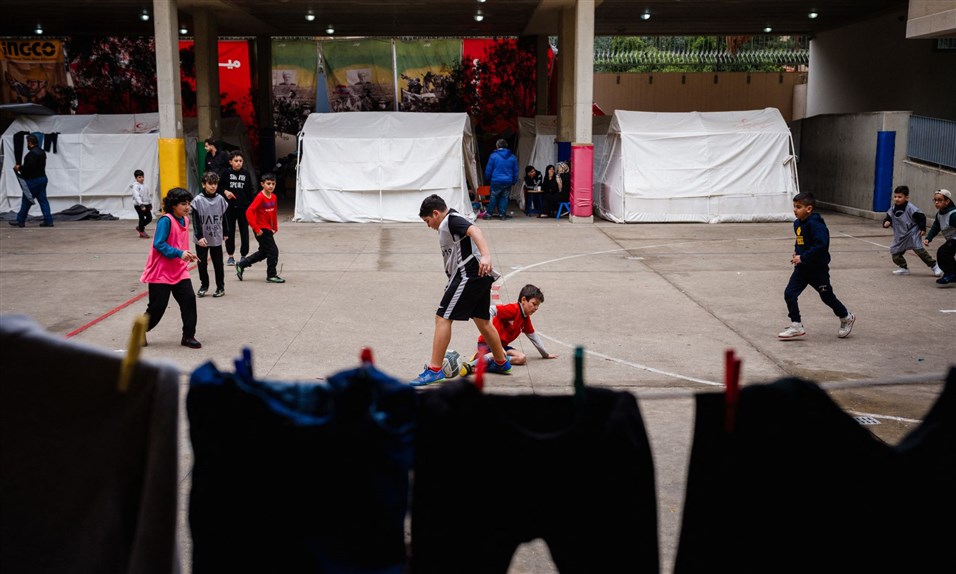 Photo by DIMITAR DILKOFF / AFP
This reform monitor is supported by the Royal Norwegian Embassy in Beirut. The opinions expressed here do not necessarily reflect those of the donor.
What is the Issue at Hand?
On 2 March 2026, renewed escalation of hostilities by Israel created a massive wave of forced displacement. At the height of the crisis, more than 1 million people were displaced. Since then, more than 4,381 people have been killed, alongside extensive destruction of homes, infrastructure, and agricultural land across southern Lebanon [1]. The scale of this destruction and an expanded Israeli invasion of Lebanese territory have left residents of dozens of villages unable to return.
As repeated ceasefires have collapsed and the outcome of several rounds of negotiations remains limited, Israeli forces continue to occupy large parts of southern Lebanon, while attacks have continued and at times intensified. As of 1 September, around 329,000 people remained internally displaced [9]. This persistent insecurity comes on top of an already acute socioeconomic crisis, compounding years of financial collapse, political instability, and unresolved structural vulnerabilities.
Findings from a Lebanese Center for Policy Studies (LCPS) study conducted in January-February 2026 highlighted widespread concerns regarding displacement, reconstruction, access to services, and the conditions necessary for return. Many participants expressed uncertainty about whether they would be able to return safely, while others questioned the state's capacity to support immediate emergency response and recovery efforts [2]. These concerns became significantly more acute following the March 2026 escalation.
The government response to the March escalation offers an opportunity not only to assess the effectiveness of Lebanon's emergency response mechanisms, but also to identify the gaps that continue to hinder responses to protracted displacement and safe and dignified return.
Preparedness and Emergency Response
Building on the National Preparedness Plan developed following the 2023-2024 phase of the conflict, the Government activated the National Emergency Operations Room (NOR) at 4:00 a.m. on the first day of escalation and appointed the Minister of Social Affairs to coordinate the national response. Drawing on this plan, 325 pre-identified collective shelter sites were activated within the first 72 hours [3].
The response was formally structured across national, governorate, and local levels. Governors were assigned responsibility for the opening and closure of shelters and the distribution of assistance outside collective shelters, while ministries led the response within their respective mandates. Coordination with the United Nations (UN) and humanitarian partners took place through the NOR and its sectoral working groups [4]. Over 600 Ministry of Social Affairs (MoSA) staff and social workers, 2,500 Ministry of Education and Higher Education (MEHE) staff, and more than 200 non-governmental organization (NGO) partners worked alongside municipalities, the Disaster Risk Management (DRM) unit, and sector ministries [4].
MoSA’s Shock Responsive Safety Net (SRSN) was activated in coordination with the World Food Programme (WFP), drawing on existing datasets from the 2024 response. It reached approximately 50,000 households within the first four days and around 140,000 households within the first weeks, providing USD 145 per household per month for up to three months [4]. MoSA announced the launch of the second phase of the program on July 27, 2026, covering 128,627 households (425,706 beneficiaries) with a total amount of 14.3 million US dollars, transitioning from broad coverage of conflict-affected households toward vulnerability-based targeting [12]. While the SRSN facilitated a rapid scale-up of emergency cash assistance, the scale of displacement, limited transfer value, and duration of support raise questions about its adequacy as displacement becomes increasingly protracted.
More broadly, although existing preparedness measures, particularly pre-identified shelter sites and coordination arrangements, provided an initial operational framework, the response also exposed significant institutional and operational constraints. Stakeholders highlighted persistent coordination challenges, limited capacity, and implementation bottlenecks, as well as difficulty reaching and supporting displaced households outside collective shelters. These challenges were compounded by heavy reliance on public infrastructure, limited resources, and continued dependence on international partners for implementation and financing.
Collective Shelter Provision
At the height of the crisis, public facilities made up the bulk of Lebanon's collective shelters, accounting for nearly two-thirds (64.6%, or 408 of 631 sites), with public schools forming the largest category [3]. Reliance on schools placed additional strain on an already stretched education system and highlights the need to diversify shelter options in future crises. The pressure is compounded by damage to school infrastructure and the inaccessibility of around 82 schools located in or near areas under occupation [11].
Crisis Financing
The humanitarian response following the March escalation was supported by successive Flash Appeals by the Lebanese government and its UN partners. First, on March 13, it called for US$308.3 million to deliver lifesaving assistance to one million people over three months, followed by an appeal for an additional US$331.5 million to extend multi-sector assistance to 1.4 million people. This brought the total revised Flash Appeal requirements for March–August 2026 to $639.9 million [7].
However, as of August 31, when the Flash Appeal officially concluded, only USD 332.4 million (52%) had been received [8] compared with 94.9% funding rate for the 2024 response [3]. This financing gap highlights Lebanon's continued dependence on external support, leaving humanitarian operations vulnerable when international funding declines.
From September through December, the response transitions to the 2026 Lebanon Response Plan (LRP) Addendum, which will provide the coordination and financing framework for addressing remaining humanitarian and stabilization needs stemming from the escalation [8]. This shift from a short-term emergency appeal to a longer-horizon plan reflects the protracted nature of the crisis. Displacement and recovery needs have extended beyond the Flash Appeal's timeline, and the transition leaves open questions of whether sufficient funding will be available for the next phase of the response.
Recommendations
The existence of a National Preparedness Plan prior to the escalation provided a strong foundation for immediate government action. The government should formalize it as a living framework, regularly reviewed and tested. Preparedness should expand beyond shelter mapping to include pre-positioned supply stocks, clear inter-ministerial protocols, and mechanisms for reaching households. Given the strain placed on the education system, the plan should also identify and equip non-educational facilities, such as sports complexes, community centers, and other public buildings that can absorb displaced populations without displacing students.
Response planning should strengthen the role of municipalities, local organizations, and experienced humanitarian actors in needs assessment and service delivery. Coordination mechanisms should prevent duplication and ensure accountability without unnecessarily delaying actors with the local knowledge and capacity to respond quickly, particularly to households outside collective shelters.
Finally, drawing on domestic resources alongside support from international sources, the government should work toward a pre-committed domestic emergency financing mechanism that guarantees a baseline level of funding independent of real-time donor pledging. Sustained engagement with international partners between crises will remain essential to securing support for both humanitarian response and longer-term recovery.
Develop a Framework for Protracted Displacement
The continued displacement of large numbers of people months after the March escalation points to the need for a structured transition from emergency assistance to longer-term support and recovery. Ongoing Israeli aggression and constrains on large-scale reconstruction has exacerbated the displacement crisis, with more than 100,000 housing units damaged or destroyed [10]. As of 1 September, around 329,000 people remain internally displaced with 17,500 registered across 184 collective shelters [9]. As early as April 2026, MoSA projected the inability of more than 150,000 people to return home once hostilities cease, a figure susceptible to change as attacks continue [4].
The government is currently developing a Lebanon Return, Early Recovery and Restoration of Basic Services Framework. Led by MoSA, the framework has not yet been finalized and consultation are ongoing, particularly with local stakeholders and international partners. As the framework is finalized, it should clearly define institutional responsibilities, eligibility, and prioritization criteria, as well as a phased transition from emergency assistance to long-term support and durable solutions.
Return and recovery planning should consider not only physical return, but the conditions necessary for a safe and dignified return, including safety, adequate housing, essential services, and sustainable livelihoods. For households unable to return, support should include rental assistance and temporary housing where needed, alongside livelihood and reconstruction assistance.
Particular attention should be given to households facing prolonged displacement and those with specific vulnerabilities, including persons with disabilities, older persons, and female-headed households. The consultation process should continue to draw on the experience of municipalities, civil society, humanitarian actors, and affected communities, with mechanisms to monitor and adapt the response as needs evolve.
Why is this important?
Lebanon’s security situation remains volatile, while large-scale displacement continues and renewed waves remain a possibility. The experience of the 2024 and the 2026 responses provides an important baseline for identifying gaps, strengthening preparedness, and improving responses to both ongoing and future displacement.
Importantly, as displacement becomes increasingly prolonged, it can no longer be treated solely as a temporary humanitarian emergency, but a long-term policy challenge. Prolonged displacement can erode resources and coping capacities, deepen socio-economic insecurity, and delay recovery.
The government’s emerging framework should therefore provide a clear transition from emergency assistance toward longer-term support and recovery for displaced households. Ultimately, the state’s credibility as the primary guarantor of its citizens’ safety, dignity, and well-being is at stake.
References
[1] Minister’s Office. (2026, September 8). Update Toll of the Aggression- 7/9/2026. MoPH. https://www.moph.gov.lb/en/Pages/129/82076/the-ministry-of-public-health-launches-the-updated-version-of-its-mobile-app#/en/Pages/129/86871/update-toll-of-the-aggression-7-9-2026
[2] Smaira, D., & Chouayfati, P. (2026). Public perceptions and lived experiences in Lebanon prior to the 2026 military escalation. LCPS. https://www.lcps-lebanon.org/en/articles/details/6052/public-perceptions-and-lived-experiences-in-lebanon-prior-to-the-2026-military-escalation
[3]Presidency of the Council of Ministers. (2026). Comprehensive Response Report: War and Internal Displacement, March–May 2026. Government of Lebanon.
[4] Ministry of Social Affairs. (April, 2026). Lebanon 2026 WAR, Displacement, and National Response. https://www.socialaffairs.gov.lb/media/jponws35/lebanon-response-dc-presentation-16042026.pdf.
[5] UN High Commissioner for Refugees. (2026, June 2). Emergency multi-purpose cash assistance (EMPCA) guidelines. ReliefWeb. https://reliefweb.int/report/lebanon/emergency-multi-purpose-cash-assistance-empca-guidelines
[6] Gebeily, M., & Al Kerdi, A. (2026, September 4). Thousands of Lebanese students still displaced by war as school year nears. Reuters. https://www.reuters.com/world/middle-east/thousands-lebanese-students-still-displaced-by-war-as-school-year-nears-2026-09-04/
[7] Revised flash appeal: Lebanon, March - August 2026 (June 2026) [en/ar]. (2026, June 4). UNOCHA. https://www.unocha.org/publications/report/lebanon/lebanon-revised-flash-appeal-june-august-2026
[8]Lebanon: Flash update #52 - Escalation of hostilities in Lebanon (as of 31 august 2026). (2026, September 2). UNOCHA. https://www.unocha.org/publications/report/lebanon/lebanon-flash-update-52-escalation-hostilities-lebanon-31-august-2026
[9] International Organization for Migration (IOM). (2026, September 3). Lebanon — Mobility Snapshot — Round 115 (03 September 2026). https://dtm.iom.int/reports/lebanon-mobility-snapshot-round-115-03-september-2026?close=true
[10] CNRS. (2026, August 4). أحدث تقييم أولي لعدد الوحدات المدمّرة والمتضرّرة وحجم الردميات على مستوى الأقضية -. National Council for Scientific Research – Lebanon (CNRS-L). https://cnrs.edu.lb/%d8%a3%d8%ad%d8%af%d8%ab-%d8%aa%d9%82%d9%8a%d9%8a%d9%85-%d8%a3%d9%88%d9%84%d9%8a-%d9%84%d8%b9%d8%af%d8%af-%d8%a7%d9%84%d9%88%d8%ad%d8%af%d8%a7%d8%aa-%d8%a7%d9%84%d9%85%d8%af%d9%85%d9%91%d8%b1%d8%a9/
[11] An-Nahar. (2026, September 7). كم مدرسة ستفتح أبوابها في لبنان؟ An-Nahar. https://www.annahar.com/lebanon/336677/العام-الدراسي-2026-2027-استراتيجية-بلا-إحصاات
[12] Ministry of Social Affairs . (2026, July 27). [Online post]. Facebook. https://www.facebook.com/ministryofsocialaffairslebanon/posts/pfbid021xLEMY7tdvx46XpEchxYUFYD95J2oTFing4hF37sJHS1VcnvbJJZbTHaGXYNgNCDl?rdid=19qAi1sfzpCJgrjq&share_url=https%3A%2F%2Fwww.facebook.com%2Fshare%2Fp%2F1BysNJabbW%2F#
Peter Chouayfati holds a BA in Political Science and International Affairs with distinction from the Lebanese American University and an MLitt in Middle East, Caucasus, and Central Asian Security Studies from the University of St. Andrews. His research focuses on Lebanese politics, democracy, governance, and migration.